

From the launch letter
The deals
he never
saw.
Michael Goodbody had spent years in Silicon Valley. He still struggled to see the rounds he wanted to join.
Michael GoodbodyCEO, Get Access
 Kov Rastogi
Selected for Sound Ventures
Five independent studies for Sound Ventures. Each starts with a company’s published story and follows one decision into a campaign, a design system and a tool you can try.
Read the portfolio 23-page PDFSelected design work
I came to design through systems engineering. These four projects show where that shows up in the work, from the photograph a buyer trusts to the inventory record behind it.
 Commerce design
A styled table becomes a path to the exact board and spreader. I designed and built the Shopify theme.
 Campaign art direction
One caramel apple latte sets the palette, type and composition for a seasonal café storefront study.
 Visual identity and product
A violet beauty campaign leads into a 19-screen Figma prototype for creators and brands.
 Live commerce and film
Two cameras can share a model number and wear differently. I built the shop to show the one a buyer will actually receive.
Get Access / Membership invitation
From the launch letter
Michael Goodbody had spent years in Silicon Valley. He still struggled to see the rounds he wanted to join.
2025
Rounds were happening inside networks he had little time to uncover.
People kept asking how he had heard about companies early enough to invest.
Membership invitationAn invitation to operators
Think of a problem you’ve solved before. Bring the experience, the introduction or the first call you could make again.
A member’s contribution ↗Michael Goodbody writes that even a career in Silicon Valley left him outside many financing rounds. His account gives the invitation a person and a reason to exist.
From the launch letter The deals he never saw. Michael Goodbody had spent years in Silicon Valley. He still struggled to see the rounds he wanted to join. Michael Goodbody CEO, Get Access
When Goodbody met Guy Oseary in 2025, Oseary had already begun working on the same problem. Goodbody joined Get Access as CEO. I set their two perspectives side by side to show where the idea came from.
Get Access The launch letter 2025 Two sides of one door. Michael Goodbody Rounds were happening inside networks he had little time to uncover. Guy Oseary People kept asking how he had heard about companies early enough to invest. They met in 2025. Oseary had begun building Get Access. Goodbody joined as CEO.
Get Access says it accepts members who can add value to a company. I turned that criterion into the opening line of a membership email and a brief a prospective member can write in their own words.
Membership invitation An invitation to operators What would a founder call you for? Think of a problem you’ve solved before. Bring the experience, the introduction or the first call you could make again. A member’s contribution ↗
Membership email · Proposed copy
Think of the last time a founder called you with a problem you’d solved before. What did you tell them? Who could you put them in touch with?
Get Access connects founders raising capital with investors who can help build the company. Start your introduction with one thing you could do on that first call.
Design language
Get Access gives its gold sunburst room on a dark field. I borrowed that restraint for the letter. Goodbody gets half the cover and the headline fits beside his face. The final frame clears the portrait away and leaves the prospective member alone with one question.

This reconstruction follows the symbol, wordmark spacing and gold finish in Get Access’s published header image. The original raster sits beside the scalable reconstruction below. Michael Goodbody’s portrait is from the Get Access launch letter.
Working design by Kov Rastogi
Write a contribution brief in your own words. Download it or copy it into your notes. Everything you enter stays in this tab.
Membership / working copy01
Member role


Nine strokes radiate around the open A. The short horizontal bar sits apart from its legs. The reconstruction follows the silhouette in Get Access’s published launch art and preserves those gaps at small sizes.
The public site pairs a wide Syne display with Schibsted Grotesk body text. Its ink and pale gold carry into the desk. The paper brief uses a serif title and ruled, left-aligned fields so someone can read one person’s offer in sequence.
Original identity and member categories ↗The product decision
The public site explains the network through five kinds of members. I kept those names and changed the writing prompt with each role. A founder can point to a launch decision. An executive can name the operation they ran. A cultural leader can describe a distribution channel they know firsthand.
For a first user test, give a founder an applicant’s completed brief and ask what they would request from that person next week. A vague answer tells us which prompt needs editing.
Get Access membership ↗fal / Filmmaker spotlight
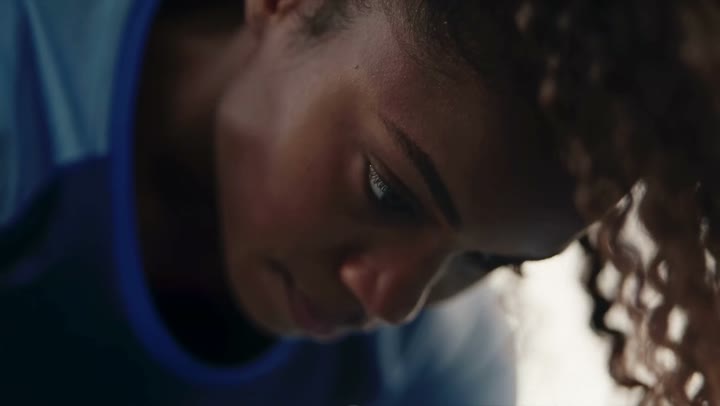
 Director’s study / The New OriginalThree opening shots / Two cuts


The wide shot sets the starting line. Two cuts lead to the runner’s face and the fingertips pressing into the track.
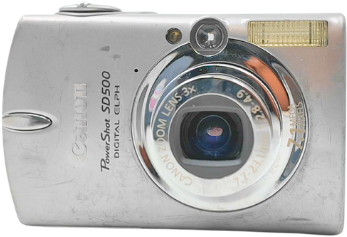
There’s wear along the front edge of this camera. Hold the shot long enough and a buyer can see it.
Claire Shin, art director at fal, made The New Original for its 2026 Generative Media Conference. Yuta Endo made the sound. Shin directed composition and camera movement for each shot.
Director’s study / The New Original Before the first stride. Film by Claire Shin Yuta Endo · Sound
A foot in the starting blocks, the runner’s face, her fingers against the track. These are the film’s first three shots. The audience feels the effort of holding still before it sees the effort of running.
Three opening shots / Two cuts Track. Face. Fingertips. 01 Starting Blocks Wide 02 Runner Face Closeup 03 Runner Hands On Track The wide shot sets the starting line. Two cuts lead to the runner’s face and the fingertips pressing into the track.
I tried the same change of scale on a piece of my own work. The silver Canon from Measure Joy has wear along its lower edge. The shopper needs enough time to see it. Try the two holds and decide where you would cut.
Application / Measure Joy Kov Rastogi · Independent cut Give the eye a second. There’s wear along the front edge of this camera. Hold the shot long enough and a buyer can see it. Adjust the cut ↗
Screening Room social caption · Proposed copy
A foot settles into the blocks. Cut to her face. Cut to the fingers holding her weight against the track. The race hasn’t started, but Claire Shin has already given us something to hold our breath for.
Watch the opening of The New Original twice. The first time, follow the runner. The second time, watch where Shin puts the camera. Film by Claire Shin. Sound by Yuta Endo.
Design language
fal pairs a bold lowercase wordmark with a compact geometric symbol. Its Screening Room credits individual makers and opens the film up shot by shot. I used the scale of a cinema title and the sequence of a contact sheet, so the images make the argument before the copy does.

The standalone lockup uses the symbol and word paths from fal’s published navigation. The letterforms and their relative size follow the source. Three opening stills from The New Original, a film by Claire Shin for fal. The camera photograph comes from the Measure Joy product listing.
Working design by Kov Rastogi
Compose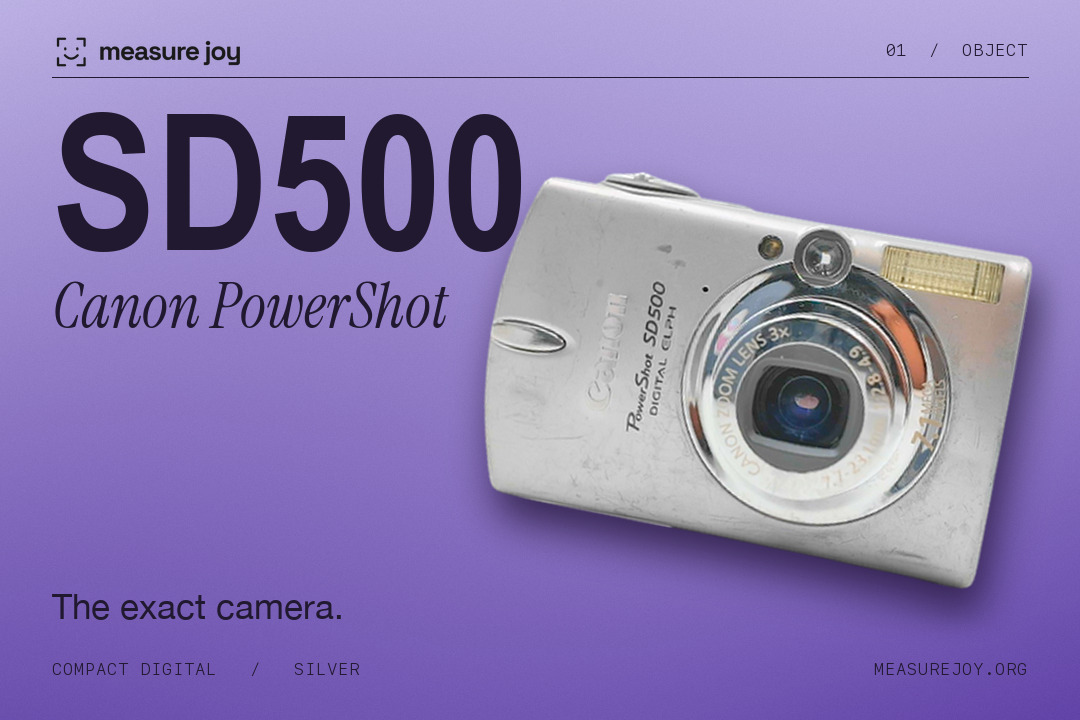
Select a shot to change its hold. Each format keeps its own cut.
Production handoff
The artwork pack contains the three frames on screen. The matching Compose file records each frame’s start and hold in milliseconds.
For a fal render, upload the three JPGs to a reachable HTTPS folder and enter its URL. Leaving this field empty exports a template with example addresses. Playback and export happen on this device.
One image track · Three timed frames
Design notes
fal provides infrastructure for generative media. Its Screening Room breaks Claire Shin’s 80-second conference film into 30 shots. Compose offers a different way to express a sequence. It accepts a visual track and timed source files.
Measure Joy’s listing supplied the photograph, condition grade and contents of this exact Canon. Those three facts became the campaign’s three shots. Kov designed the storefront and this independent study.
I kept the monitor and timing controls in charcoal so the artwork carries the color. The Measure Joy lockup comes from the storefront’s own masthead. Violet introduces the silver body. An enlarged crop on yellow lets a buyer inspect its edge. The black packing list gives every included item a line of its own.
The picture track exposes the same timing that appears in the export. An editor can lengthen the condition shot and a developer can inspect the resulting change. I’d test the handoff by asking one of each to deliver the same cut without re-entering a timestamp.
These earlier edits tested a one-second and three-second hold on the same camera. Both run four seconds.
Claire Shin’s shot breakdown ↗fal on creative production ↗Compose input schema ↗Original Measure Joy listing ↗
Factory / Customer story

 Customer fieldnotes / Empower
Empower’s engineers worked across five regions. A question about a code change could wait until another team woke up.
Empower / The handoff
Factory reports that in some cases, the time from opening a pull request to approval fell by as much as 50%.
Proposed campaign / Review handoffA pull-request template for teams that hand work across time zones. Attach it to the change before asking for a review.
Name the behavior the user will notice.
Link the test and its result.
Leave one decision for the next reviewer.
Factory’s customer account describes a distributed engineering team at Empower. Time differences delayed feedback. The opening puts that human wait ahead of the performance number.
Customer fieldnotes / Empower Waiting on morning. Empower’s engineers worked across five regions. A question about a code change could wait until another team woke up. United States New Zealand South America Canada Australia
The screenshot is a QA impact-analysis request Factory published with the Empower story. Separately, Factory reports that review automation often shortened the time from opening a pull request to approval by as much as 50%.
Empower / The handoff What changed in this pull request? Separate QA impact-analysis example from Factory Up to 50 % Factory reports that in some cases, the time from opening a pull request to approval fell by as much as 50%.
I built a handoff that another engineer can verify. Run six checks against my Arcade viewer, then download a note with the page titles, button states and image results your browser actually observed.
Proposed campaign / Review handoff Leave the next reviewer a handoff. A pull-request template for teams that hand work across time zones. Attach it to the change before asking for a review. Review note 01 What changed? Name the behavior the user will notice. 02 What did you check? Link the test and its result. 03 What needs a call? Leave one decision for the next reviewer. Independent campaign copy · Kov Rastogi
Pull-request handoff card · Proposed copy
You’re ready for a second pair of eyes. Your reviewer is asleep. Before you sign off for the night, leave three things in the pull request.
What changed for the person using the product? What did you check? Which decision still needs another engineer? A reviewer in the next time zone can start there.
Design language
Factory places its geometric wordmark beside orange artwork for Empower. I used those two elements for a field note that engineers could recognize in a pull request. The orange draws the eye to the next action. Neutral paper carries the request, the result and the handoff.

The lockup reuses the visible paths of Factory’s official header SVG. Website animation and hidden paths were removed for a stable editorial asset. Empower artwork and review reference from Factory’s customer story. The working viewer is a separate example from Kov’s Arcade spotlight.
Working design by Kov Rastogi
Browser review / Kov’s portfolio
Factory documents code review as feedback attached to a change. This desk pairs a release note with a working interface. The checks run locally on my published Arcade viewer script and report what this browser observes.
Evidence log
Ready for a local run.
The live-region check reads the markup. Verifying the spoken announcement requires a screen-reader session.
Design decision
Factory’s Empower case describes time-zone delays in code review. Its product puts feedback beside the code it concerns. I carried that proximity into a handoff: the interface sits beside the test results, and the note preserves the actual page titles and browser states for the next reviewer.
The warm orange is reserved for actions and exceptions. Page titles, observed values and comparison labels do the explanatory work in monochrome.
Warp / Founder profile
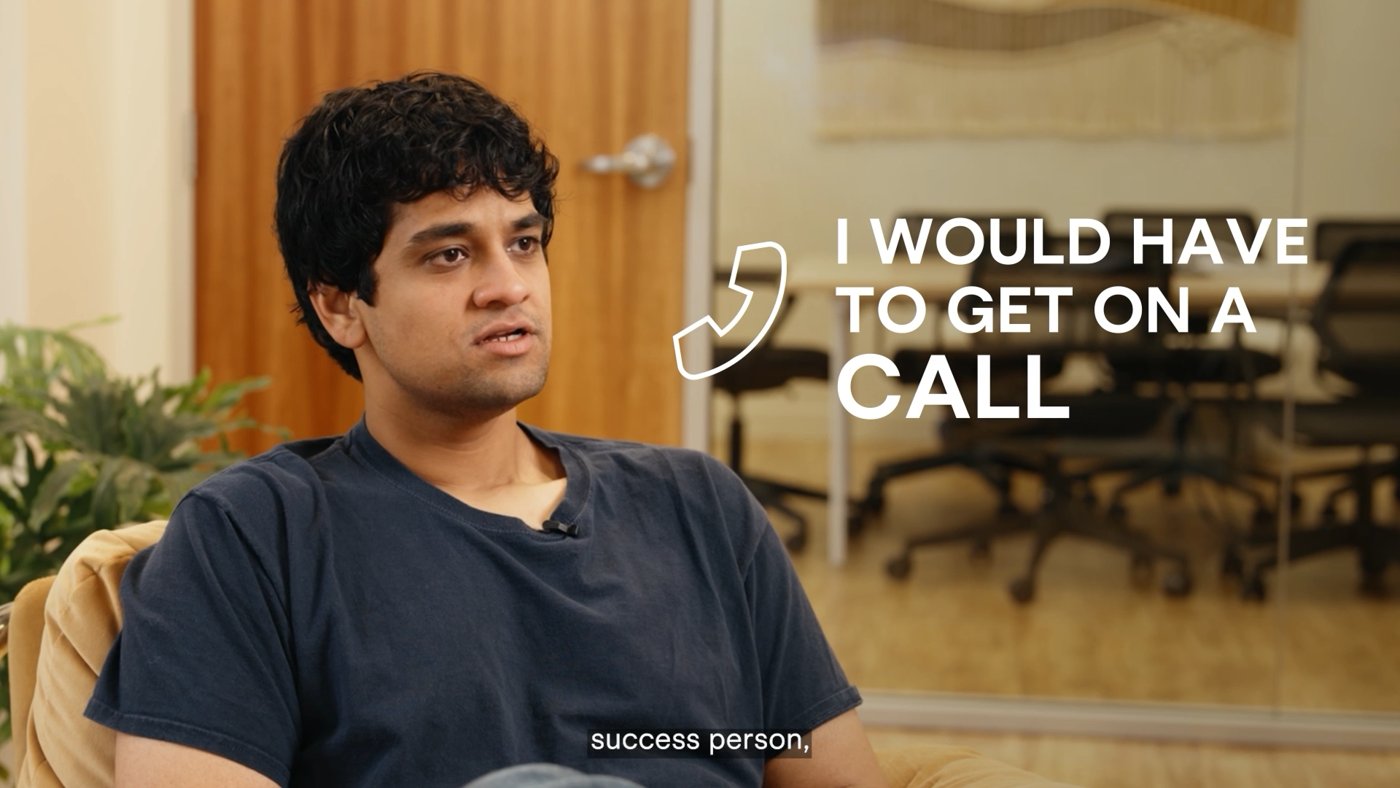
 Julius / Founder interview
Julius founder Rahul Sonwalkar describes how worrying about tax notices took time away from building the product. His team moved from Rippling to Warp.
Rahul Sonwalkar · Still from Warp’s customer film
From Warp’s published compliance demoOne state can still be processing when the employer has nothing left to submit. The status needs an owner.
Jurisdiction summary
13jurisdictionsProposed campaign / The handoff receiptSend a founder one short receipt whenever a filing changes hands.
Keep this receipt with the filing. Check the next update for a change in status.
Suggested copy for the waiting-on-agency stateIn Warp’s account, Julius moved from Rippling. Founder Rahul Sonwalkar describes how tax notices and payroll had taken time away from building the product. The portrait keeps the story with the person who made the switch.
Julius / Founder interview The work after payroll. Julius founder Rahul Sonwalkar describes how worrying about tax notices took time away from building the product. His team moved from Rippling to Warp. Rahul Sonwalkar · Still from Warp’s customer film
In a separate public walkthrough, Warp shows Colorado opening withholding, Illinois opening unemployment and Georgia waiting on the agency. The display illustrates Warp’s product. These entries are not identified as Julius’s filings.
From Warp’s published compliance demo Waiting on whom? One state can still be processing when the employer has nothing left to submit. The status needs an owner. Jurisdiction summary 13 jurisdictions 10 Compliant 03 Processing Georgia Waiting on the agency Product example from Warp. The figures describe the demo account.
The proposed receipt translates one of Warp’s public statuses into a sentence a founder can act on. Open the register, select Georgia and add the follow-up you would want the next person to see.
Proposed campaign / The handoff receipt Give the notice an owner. Send a founder one short receipt whenever a filing changes hands. Filing handoff Georgia It’s with the agency. Keep this receipt with the filing. Check the next update for a change in status. Suggested copy for the waiting-on-agency state
Filing-status email · Proposed copy
Georgia’s filing is with the agency. If you came here wondering whose move it is, that’s the answer for today.
Keep this receipt with the filing. When a notice arrives or the status changes, the next person who opens Georgia can see where you left off.
Design language
Warp gives its founder interviews a warm palette and its state register a compact, orderly layout. I used the interview portrait at the scale of a magazine cover. On the next page, each registration gets its own line. In the email, the next owner fits in the subject.

The standalone wordmark and curved emblem come from Warp’s published header. I retained the clipping geometry that defines the symbol. Rahul Sonwalkar in the interview stills published by Warp. Jurisdiction counts come from Warp’s separate public product walkthrough.
Working design by Kov Rastogi
State registerPublished product exampleRegistration status
Opening withholding
Pair a published status with your own follow-up. Notes stay in this page while it is open.
Warp groups jurisdictions by registration state and lets people inspect the ones still processing. The register above reproduces its public walkthrough. Julius describes its own payroll experience in a separate customer story.
Julius and Warp ↗I kept the status labels and counts intact. Thirteen ticks give the operator a quick overview. The selected state opens as a work slip. Blank fields let an operator claim the next step without changing Warp’s published record.
A payroll lead covering someone’s shift can export just the states that need a conversation. I’d test whether a second operator can name the open registration and distinguish the source status from the team’s note.
Independent product extension by Kov Rastogi. Jurisdiction counts, dates and statuses are from Warp’s public product example.
Anomaly Insights / Case editorial
 Inova / Revenue cycle
A hospital team receiving a denial has an earlier decision to make. Which policy applies, and what action does the evidence support?
Medical necessity denials / Decision sheetInova results / Proposed workshop invitationRecovered in the first 90 days of Anomaly’s work with Inova, according to Anomaly.
Estimated ongoing monthly impact. A separate estimate from the 90-day recovery.
Bring the remittance, the coverage policy and the claim history. Use the five-route sheet to decide who should act next.
Dan Samarov’s account of Anomaly’s work with Inova includes the perspective of Erin Hodson, Inova’s VP of Revenue Cycle. It starts with a practical question for the team facing a medical necessity denial. Does this claim call for an appeal at all?
Inova / Revenue cycle Before anyone writes an appeal. A hospital team receiving a denial has an earlier decision to make. Which policy applies, and what action does the evidence support? Remittance Coverage policy Revenue cycle / Working papers Appeal letter Check the policy first Dan Samarov’s account for Anomaly, with Erin Hodson, Inova’s VP of Revenue Cycle.
Anomaly describes five actions for medical necessity denials. A reversal can close the matter. A record may require review or support a write-off or an appeal. A recurring issue can belong with the managed-care team. Each row on the sheet has its own evidence and next step.
Medical necessity denials / Decision sheet One denial. Five possible routes. 01 No action A later remittance shows the denial was reversed. 02 Chart review Review the record before correcting and resubmitting a code. 03 Write-off The record and plan support no covered diagnosis. 04 Appeal The documented diagnosis meets the payer’s coverage criteria. 05 Managed care Clarify a policy or challenge a pattern across claims with the payer.
Anomaly reports $10.4 million recovered with Inova in the first 90 days. It separately estimates $3.8 million in ongoing monthly impact. The workshop invitation beside those figures asks a team to apply the method to one case of its own.
Inova results / Proposed workshop invitation $10.4 m Recovered in the first 90 days of Anomaly’s work with Inova, according to Anomaly. $3.8m Estimated ongoing monthly impact. A separate estimate from the 90-day recovery. Workshop invitation · Proposed copy Bring one denial. Choose its next route. Bring the remittance, the coverage policy and the claim history. Use the five-route sheet to decide who should act next.
Revenue-cycle workshop invitation · Proposed copy
Bring the remittance, the coverage policy and the claim history. We’ll use one denial to answer three questions. Has a later submission already reversed it? What does the policy cover? Who owns the next step?
Leave with one decision for this claim and one question worth putting to the payer.
Design language
Anomaly places a single blue dot beside a black wordmark. Its illustrated product stories use color to distinguish decisions. I used the dot beside each possible action and kept reported revenue, time period and attribution together so the figure survives a screenshot.

The reconstruction follows the published header artwork in two vector color layers. The placement of the blue dot, counters and letter spacing follow the original raster. Outcome and action categories reported by Anomaly. The companion starts with the reader’s own notes and amounts.
Working design by Kov Rastogi
/ Evidence worksheetMedical necessity denialsFive actions for medical necessity denials
Action 04 / 05
The governing policy covers the documented diagnosis. Anomaly describes the denial as a candidate for an appeal citing that policy.
Your working paper
Add your own non-identifying summary. Source findings and worksheet amounts stay separate.
Anomaly’s Inova Health account distinguishes revenue recovered in the first 90 days from an estimate of future monthly impact. In that account, Anomaly describes five actions for medical necessity denials and the policy evidence that separates them.
Inova account and method ↗I turned the five actions into an index. A reader chooses an action and sees the evidence to inspect. An ink-red rule connects the action to the governing record. A separate ivory sheet holds only what the reader enters.
The printed brief carries each policy reference and its note to a review meeting. I’d test whether a reader can distinguish a claim-level appeal from a recurring issue that belongs with managed care.
Independent product extension by Kov Rastogi. The worksheet starts empty and processes entries on this device.
Arcade · Independent maker spotlight
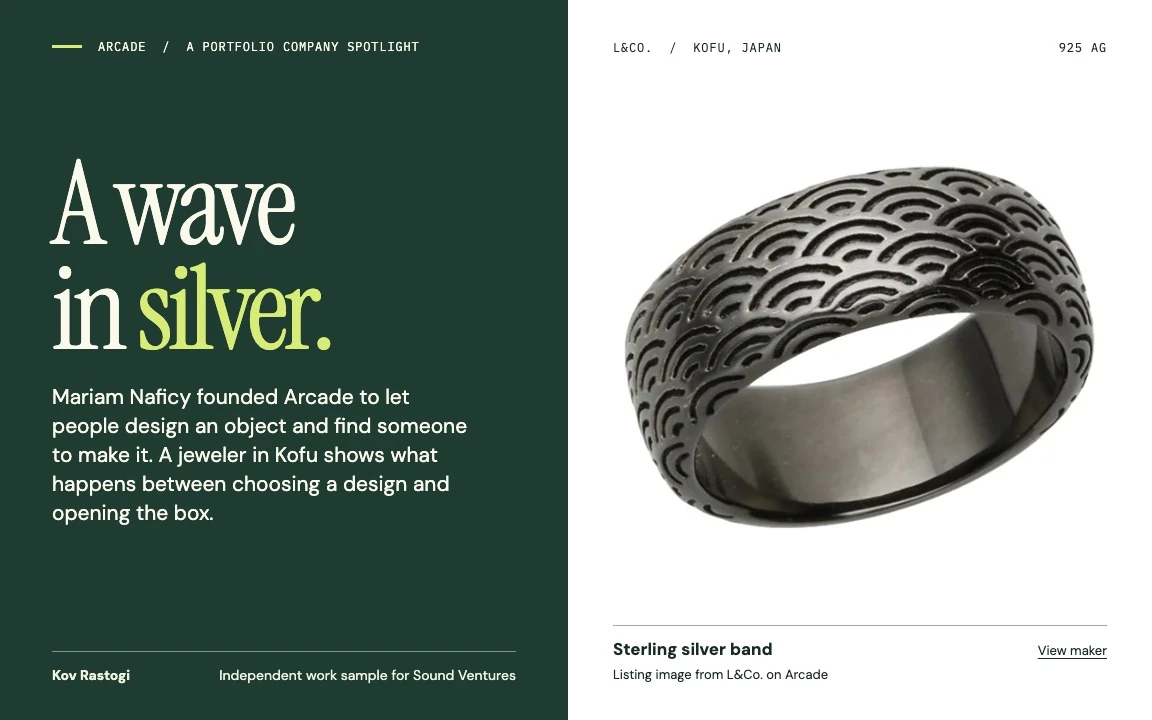
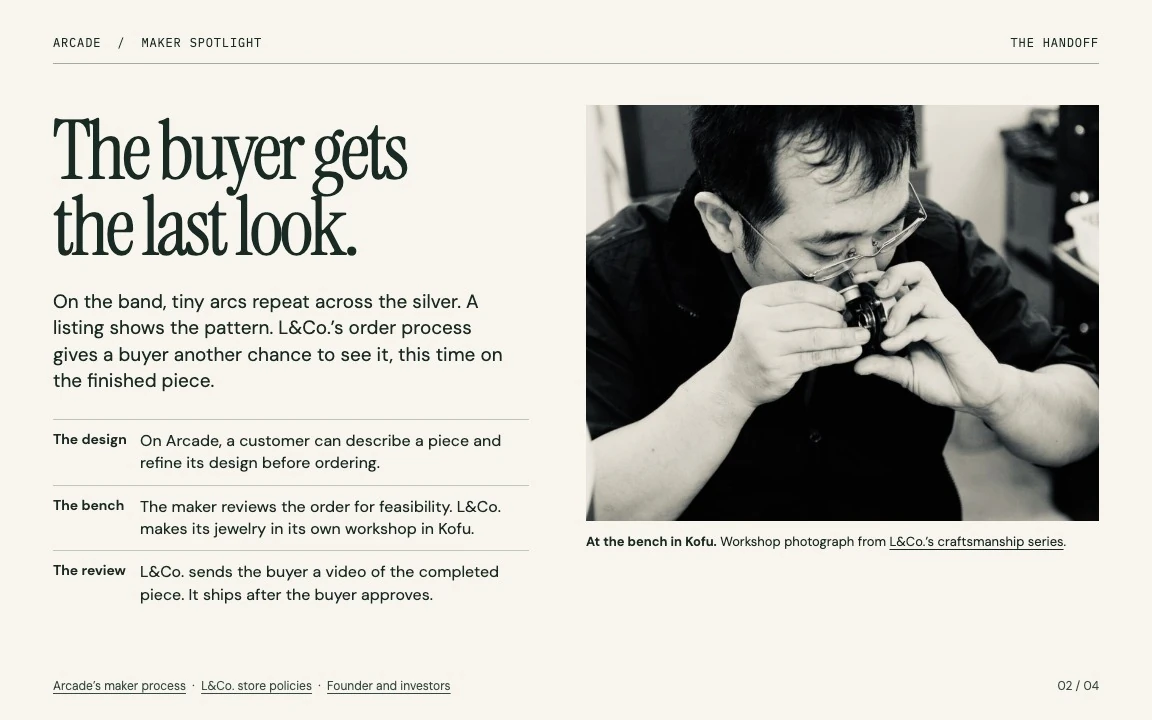
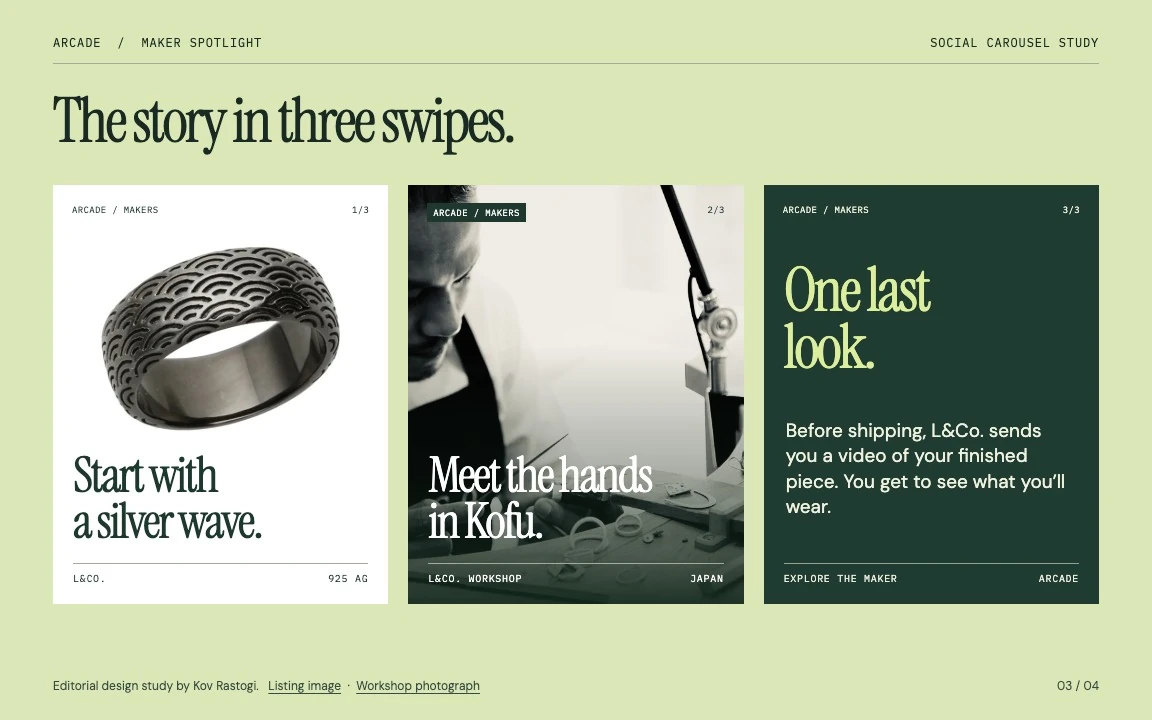
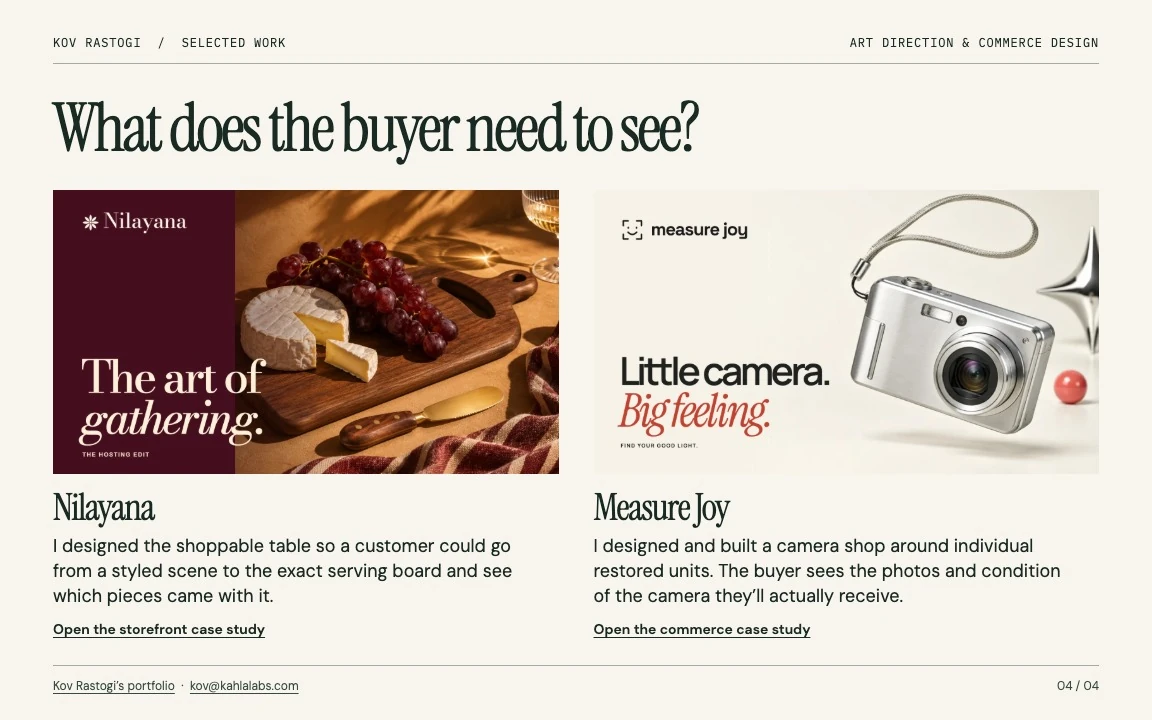
1 / 4 · A wave in silver
I followed one silver ring from its Arcade listing to L&Co.’s workshop, then adapted the story into three social cards.
Open the full spotlight (PDF)Measure Joy · Product film
A buyer can inspect the exact camera, its condition and its kit in the Measure Joy storefront. This is the original 15-second silent film.
“Which camera will I actually get?” A silver Canon PowerShot SD500 appears, graded Good. “What comes with it?” The listing includes the camera, a battery and charger, and a new SD card. Storefront design and development by Kov Rastogi.